About
Dreams Happen After Dark — statement
I walk.
The silence opens a small, fragile space inside the night.
Somewhere in the dark, another world comes close.
My images begin here.
Everyday life sometimes leaves me with a feeling of incompletion, of lack — the vague impression of standing at the edge of the stage, watching life unfold a little further away.
Dreams Happen After Dark is not a series about the night. It is a series about the need for elsewhere. An intimate quest, sometimes lucid, sometimes stubborn, to find within reality a doorway to a denser world — less futile, more vibrant.
Night then becomes my field of research. I walk through it in search of fragments of that other world. Not a precise place, but rather a sensation: an intensity, a coherence, as if the world suddenly became more legible.
Cinema rooted this obsession in me very early on. Not because it shows perfect worlds, but because it gives a perfect form to imperfection: a frame, a light, a tension, a piece of music. A way of making uncertainty beautiful, solid, habitable.
Light is both subject and tool. I often push it further by adding my own — flashes or colored beams, placed directly on location at the moment of shooting. It is not an effect added afterwards, but a gesture that opens reality to another reading.
Like turning on a radio: the waves were already there, but a device was needed to make them perceptible.
In these images, the city is almost always empty. Absence leaves the scene intact. Silence becomes a material. And this emptiness points to something deeply human: even though we are social beings, our inner life remains solitary. The empty city then becomes the mirror of that inner space — calm, strange, sometimes unsettling, often magnetic.
Travels through Asia and the United States play an essential role in this work. The density of Asian megacities, like the openness of American suburbs, shifts my gaze and blurs the boundary between documentary and fiction. The city is not shown as it is, but as it reappears when the world falls asleep and silence takes the stage again.
And yet, I am aware of the paradox: this “other world” is, ultimately, a personal construction. This quest cannot truly be resolved outside of myself. But the act of searching matters: walking, scanning, waiting, recognizing, framing, transforming.
These images are neither documents nor embellishments. They are invitations: spaces to inhabit rather than simply observe, carefully lit fragments of silence, where reality begins to behave like fiction — and where fiction suddenly feels almost real.
The artist
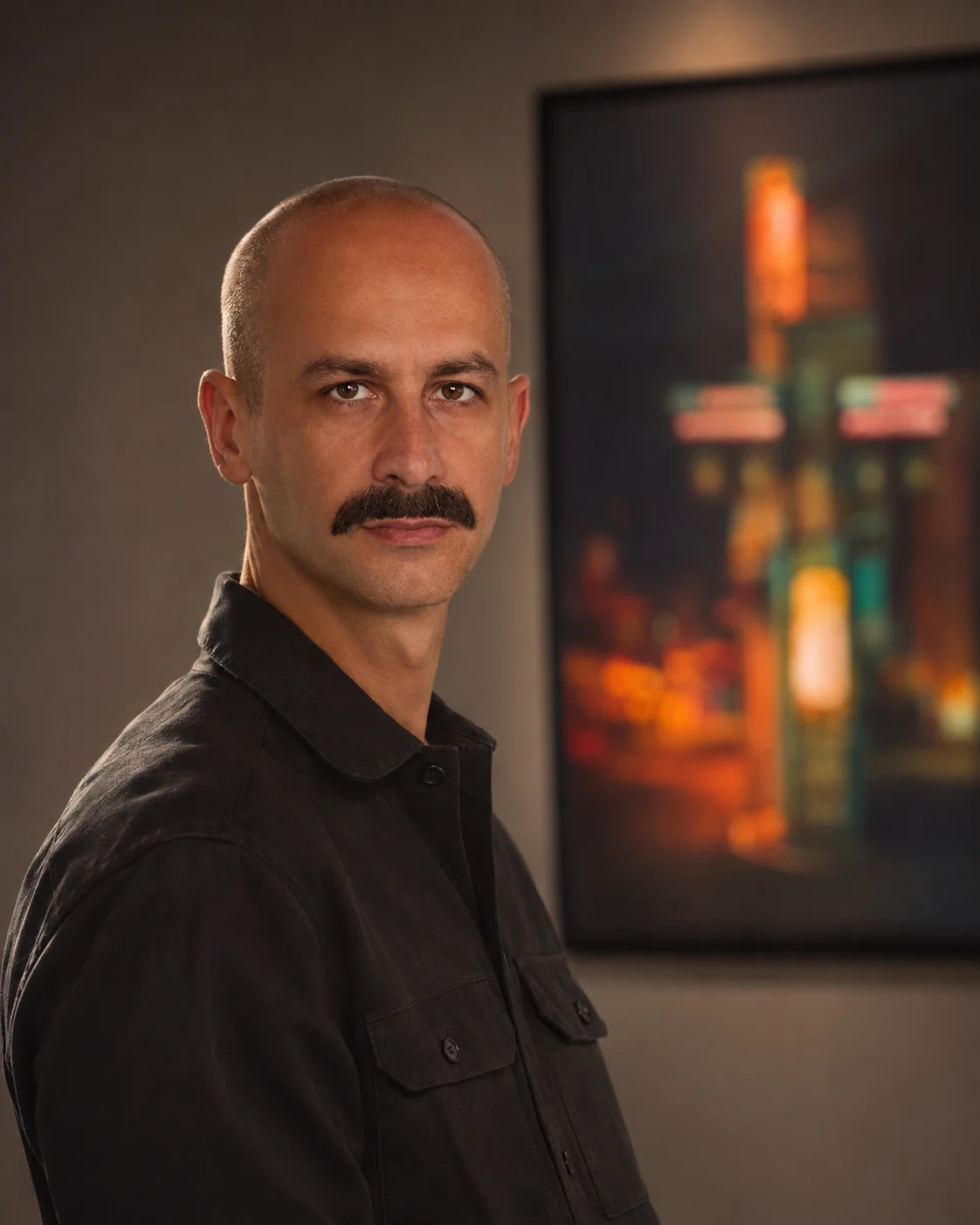
Etienne Perrone is a French photographer and award-winning filmmaker. Active in the field of image-making since the early 2000s, he has developed a photographic practice now centered on Dreams Happen After Dark, a nocturnal body of work shaped by light, compositional tension, and the precise use of colored flashes directly on location.
Through this series, he explores the city as a mental and sensory space: a place where silence, artificial light, and emptiness transform ordinary urban fragments into charged, unstable, and cinematic images. His photographs seek out those fragile moments when the visible world becomes denser, stranger, and more open — as if another reality were beginning to press through.
Shaped by a long-standing practice of cinema, photography, and staging, he develops work in which formal precision is always used in service of atmosphere, intensity, and emotional depth. His images are built to hold a tension: between reality and fiction, presence and absence, stillness and latent drama.
Awards & recognition
- 2026 — Finalist, LensCulture Street Photography Awards (entries from 124 countries)
- 2026 — Finalist, AOP Open Award, Series category — Association of Photographers, London, UK
- 2026 — Photographer of the Month, The Glasgow Gallery of Photography, UK
- 2025 — Juror's Pick, LensCulture Street Photography Awards
- 2018 — Editor's Pick, Life Framer
Upcoming
- 2027 — Ras Al Khaimah Art Festival, UAE — Tired, Midnight Split
- 2027 — AOP Open Awards Finalists' Exhibition, London, UK
Group exhibitions (selected)
- 2026 — Urban, The Glasgow Gallery of Photography, Glasgow, UK — image selected as the exhibition's key visual
- 2026 — ABANDONED, DUSK Gallery, Santa Fe, New Mexico, USA
- 2026 — Camera Work: Shadow and Light, Black Box Gallery, Portland, Oregon, USA
- 2025 — Rencontre et Harmonie des Nations, Beijing, China
- 2025 — Dialogue Artistique International Culture, Shenzhen, China
- 2005 — Sharjah Art Museum, Sharjah, UAE — Distortiologie series
Solo exhibitions
- 2019 — Too Late, Ici Est l'Art / Épicentre Factory, Clermont-Ferrand, France
- 2017 — Galerie Jour et Nuit, Paris, France
- 2004 & 2005 — Galerie Swap, Lyon, France
Publications & press
- 2026 — Dodho Magazine — interview, A conversation about Dreams Happen After Dark
- 2026 — Noice Magazine — online feature and portfolio
- 2025 — The Guardian — LensCulture Street Photography Awards gallery
- 2019 — La Montagne — on the exhibition Too Late
- 2018 — Subjectively Objective, Vol. 45 — mini-monograph, edition of 65 numbered copies
- 2018 — Feature Shoot — online feature
- Open Doors Gallery — online feature
Collections
- Private collections in France, the United States, Switzerland, Belgium, Spain, the United Kingdom, Canada and Germany
- Kevin Barry Fine Art Advisory, Los Angeles — hospitality projects
Background
- Since 2000 — Director and cinematographer
- 2019 — Gloom // Bloom, experimental short film, selected and awarded at international festivals
Contact
I reply to every message personally. Get in touch.